
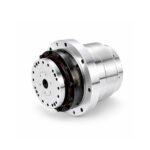
 Joint Rotary Actuators Series HAT
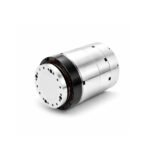 Joint Rotary Actuators series HAS
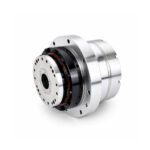 Joint Rotary Actuators Series HAMF
 Frameless Torque Motor HBM
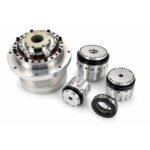 Rotary Actuators
 Joint Rotary Actuators Series HAG
 Rotary Actuators Series HPG

Introduction: Never Having to Say “Home” Again
For anyone who has commissioned a traditional industrial robot, the startup ritual is painfully familiar. Upon powering up the system, the robot initiates a slow, cautious “homing” sequence. The arms must physically crawl until they trip a mechanical limit switch or an optical sensor, allowing the controller to find a reference zero point.
While this ritual is standard practice for open-loop or basic incremental systems, it introduces downtime, increases cycle startup times, and carries a latent risk of physical collisions if the workspace isn’t completely clear. In modern robotics, efficiency demands immediate readiness. The solution lies in advanced positioning hardware: the multi-turn encoder. This guide explores how absolute multi-turn feedback works and why it is transforming the design of high-performance robotic joints.
Single-Turn vs. Multi-Turn: Understanding the Difference
To appreciate the technology, we must first distinguish between the three primary tiers of rotary feedback devices.
The 360-Degree Limit of Single-Turn Feedback
A standard single-turn absolute encoder provides a unique digital code for every exact angle within a single 360-degree rotation. The moment the shaft completes one full revolution, the code repeats. While this is adequate for simple pivoting gimbals or limited-angle actuators, it presents a problem for multi-axis robotic arms where joints (like the base rotation or shoulder) often spin continuously through multiple rotations.
Tracking Unlimited Revolutions with Multi-Turn Architecture
A multi-turn encoder takes absolute feedback a step further. It not only tracks the exact position within the current 360-degree circle, but it also records how many complete revolutions the shaft has made since initialization. Whether the joint rotates forward by five rotations or backward by twelve, the encoder maintains a definitive, absolute count of total angular displacement.
How Multi-Turn Encoders Remember Position Without Power
The greatest engineering challenge of multi-turn feedback was answering a simple question: How do you keep track of revolutions when the machine is completely turned off? Over the years, engineers developed three primary solutions.
Mechanical Gear-Train Counting vs. Electronic Battery Backup
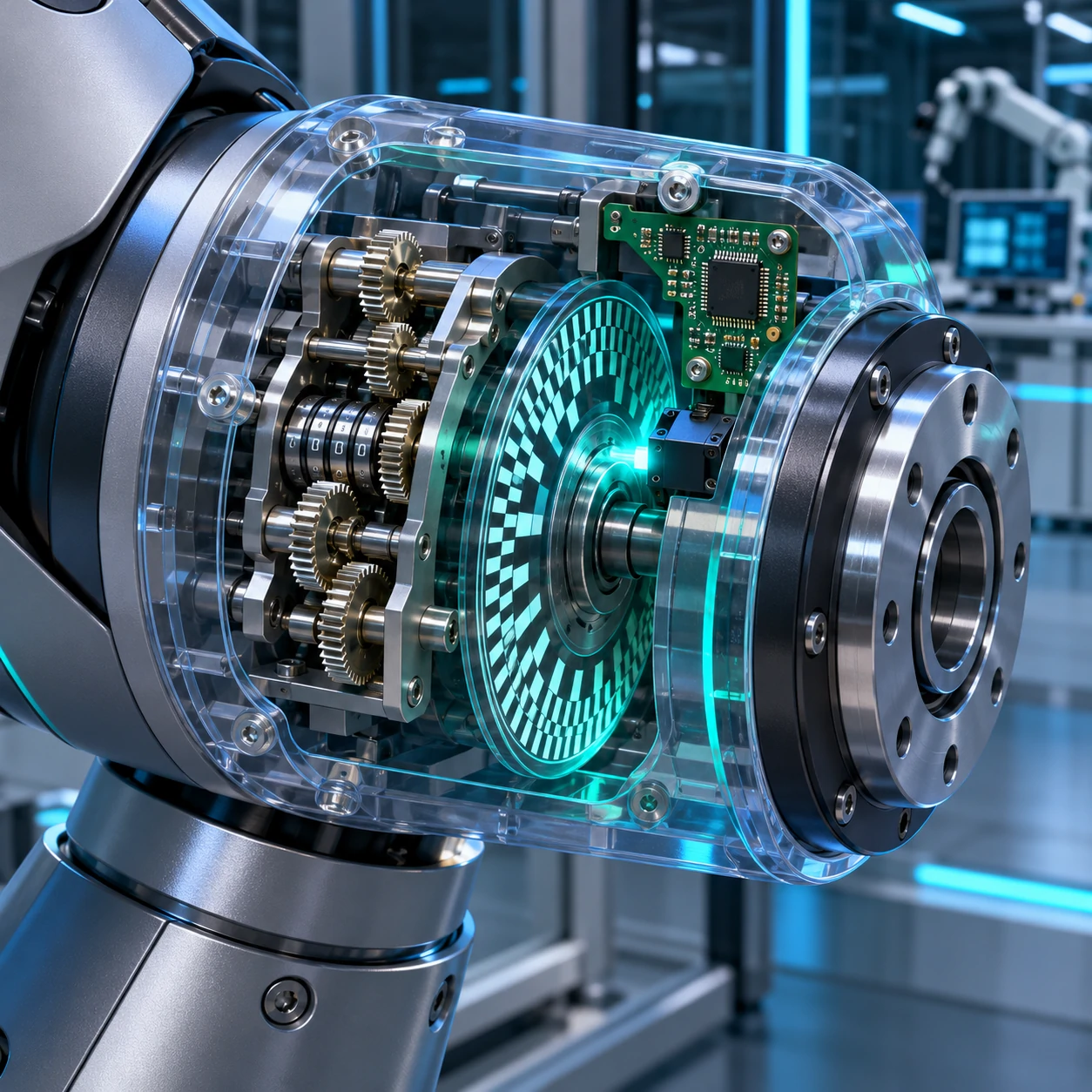
The traditional approach utilizes a miniature mechanical gear train attached to the encoder disc. As the main shaft turns, the internal gear train steps through a series of secondary discs, mechanically logging each revolution.
Alternatively, many systems use electronic multi-turn tracking backed by a small lithium battery. The electronics continuously track shaft movement while unpowered, logging turns into low-power memory registers. While effective, battery-backed systems require periodic maintenance to inspect and replace aging batteries before they drain.
Battery-Less Energy Harvesting Technology (Wiegand Effect)
The cutting edge of multi-turn feedback relies on battery-less energy harvesting, most notably the Wiegand effect. Using a specially treated, highly permeable alloy wire wrapped in a pickup coil, these encoders generate a tiny electrical pulse every time the motor’s magnetic rotor passes by. This self-generated pulse carries enough energy to wake up an ultra-low-power electronic counter and record the revolution change, eliminating the need for internal batteries or mechanical gears entirely.
Why Multi-Turn Absolute Encoders are Crucial for Robotic Joints
Integrating multi-turn absolute feedback into an actuator fundamentally elevates the capabilities of the host machine.
Eliminating Startup Homing to Prevent Accidental Collisions
By providing instant absolute data the microsecond voltage is applied, multi-turn feedback completely eliminates startup homing sequences. The robot knows its exact physical posture anywhere in its kinematic envelope upon boot-up. This capability prevents unexpected motion vectors, protecting expensive tooling and nearby equipment from accidental initialization collisions.
Preserving Joint Coordinates During Sudden Power Outages
If a facility experiences an unexpected power blackout mid-operation, traditional systems lose their reference tracking. With a multi-turn absolute system, the coordinates are locked in stone. When power returns, the robot can resume its precise task midway through a cycle without requiring manual operator intervention or error-recovery scripts.
Integrating Absolute Feedback into Compact Actuators
Designing absolute feedback into modern automation hardware requires high-density engineering.
Overcoming Space Constraints in Robotic Wrist and Elbow Axes
Robot wrists and elbows are notoriously tight on space. Integrating a multi-turn absolute system into a compact joint module requires miniaturized optical or magnetic sensor arrays that fit seamlessly within the motor bearing assembly without expanding the outer envelope of the actuator.
Maintaining High Resolution Amidst Compact Multi-Turn Designs
Achieving high-resolution multi-turn feedback without sacrificing dynamic responsiveness demands meticulous signal processing. Advanced actuators pair multi-turn tracking with high-speed serial protocols, ensuring that position data streams to the servo drive without latency or thermal drift.
Conclusion: Absolute Certainty in Motion Control
In the demanding landscape of modern automation, uncertainty is the enemy of productivity. The transition from blind incremental counting to intelligent, battery-backed or energy-harvesting multi-turn feedback represents a massive leap forward for mechanical reliability.
By eliminating startup delays, safeguarding absolute coordinates against blackouts, and enabling true plug-and-play operation, the multi-turn encoder transforms robots from reactive machines into instantly ready autonomous assets. When designing next-generation robotics, absolute certainty at the joint level is the ultimate engineering advantage.
FAQ Section: Absolute Encoder Engineering Q&A
Q1: How many revolutions can a standard multi-turn encoder track before resetting?
Most standard industrial multi-turn encoders can track up to 4,096 revolutions (12 bits of revolution data) or even up to 65,536 revolutions (16 bits) depending on the electronic or mechanical design. This provides a massive operational window that far exceeds the maximum mechanical rotation limits of standard multi-axis robotic joints.
Q2: Do battery-backed absolute encoders require field maintenance?
Yes. Systems that rely on internal lithium batteries to maintain revolution counts during power-down states require scheduled maintenance to replace the battery cells before their charge is depleted. Failing to do so risks losing multi-turn data upon power loss, necessitating a manual re-homing process. This is why many modern high-reliability designs lean toward battery-less energy-harvesting alternatives.
Q3: How does a multi-turn absolute encoder survive heavy magnetic fields or mechanical vibration in a robot joint?
High-end multi-turn absolute encoders designed for robotic joints utilize robust inductive or optical sensing grids and hardened mechanical components. They are engineered and tested to withstand high G-force shocks, continuous operational vibration, and moderate stray magnetic fields without corrupting the absolute position data stream.