 Joint Rotary Actuators Series HAT
 Joint Rotary Actuators series HAS
 Joint Rotary Actuators Series HAMF
 Frameless Torque Motor HBM
 Rotary Actuators
 Joint Rotary Actuators Series HAG
 Rotary Actuators Series HPG
Introduction: Silencing the Scream of High-Gain Motion
In the world of high-performance motion control, speed and precision are usually at odds with stability. Every engineer has experienced that frustrating moment during commissioning: you increase the gains to achieve a faster response, only for the machine to erupt into a high-pitched “scream” or a low-frequency wobble.
This instability, caused by mechanical resonance, is the single greatest bottleneck to machine productivity. Simply lowering the gains might stop the noise, but it also makes your system sluggish and imprecise. To push your machine to its physical limits, you must master vibration suppression. This guide explores the advanced tools available in modern servo tuning to eliminate jitter and ensure rock-solid stability.
Understanding the Root Causes of Servo Oscillation
Before we can suppress vibration, we must understand its origin. Vibration in a servo system is rarely an electrical failure; it is usually a physical response to control commands.
Mechanical Resonance: The Natural Frequency Trap
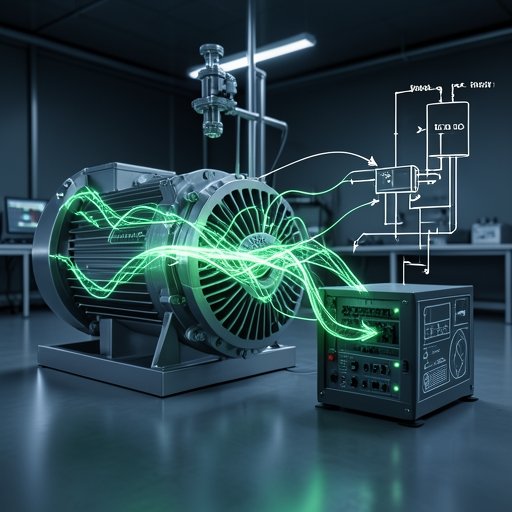
Every mechanical structure—the robot arm, the coupling, or the machine bed—has a “natural frequency.” When your servo drive’s control loop operates at or near this frequency, it excites the mechanics, causing them to vibrate like a tuning fork. This is mechanical resonance. If the control loop reinforces this vibration, the system enters a state of sustained oscillation.
Compliance and Backlash in the Drivetrain
The “stiffness” of your system plays a huge role. Compliance (flexibility) in belts, long shafts, or thin-walled housings acts like a spring. When the motor tries to stop, the load “bounces” against this springiness. Combined with mechanical backlash, these factors create non-linear disturbances that confuse the controller and trigger jitter.
Traditional Methods vs. High-Performance Tuning
In the past, the only way to handle a vibrating machine was to compromise.
Why Lowering Gains is a Compromise to Productivity
The traditional “fix” was to turn down the Proportional (P) gains. While this stops the vibration, it also reduces the system’s “stiffness” and bandwidth. The result is a machine that overshoots its target, takes longer to settle, and ultimately produces fewer parts per hour. This is an unacceptable trade-off in competitive manufacturing.
The Role of Feedforward Control in Smooth Paths
Instead of just reacting to errors, high-performance systems use Velocity and Acceleration Feedforward. This allows the drive to anticipate the torque required for a move, reducing the workload on the PID loop and allowing for smoother motion without having to “crank up” the sensitive feedback gains that often trigger resonance.
Using Notch Filters to Eliminate High-Frequency Jitter
The most effective weapon against high-frequency resonance is the Notch Filter.
How to Identify the Resonance Frequency
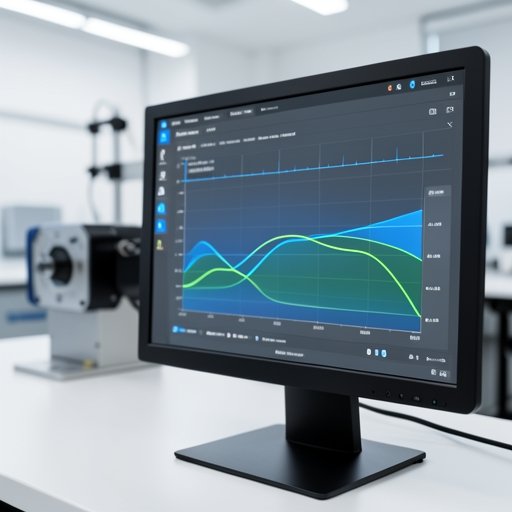
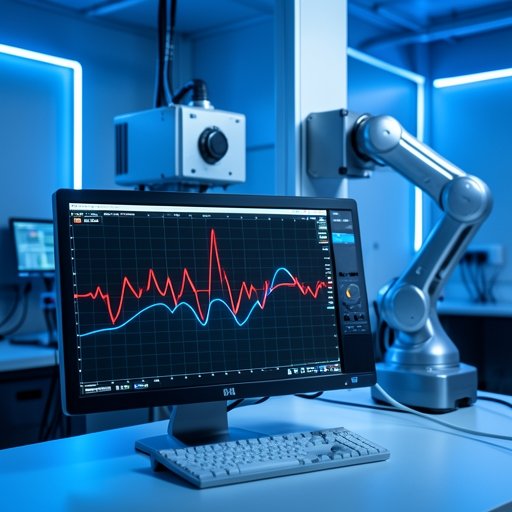
Modern software tools associated with the GSHD servo drive allow you to perform a “Frequency Analysis” (Bode Plot). By injecting a sweep of frequencies into the motor, the drive identifies the exact point where the mechanical gain spikes. If the analysis shows a peak at 850 Hz, that is your resonance frequency.
Configuring Multiple Notch Filters for Complex Structures
A Notch Filter is a digital “hole” in the frequency spectrum. You configure the filter to block the exact 850 Hz frequency while letting all other frequencies pass through. High-end drives can support up to four or more independent notch filters, allowing you to suppress multiple resonant points caused by different machine components simultaneously.
Intelligent Features of the GSHD Servo Drive
Hobber Drive’s GSHD servo drive series takes suppression a step further by integrating artificial intelligence into the control loop.
Adaptive Vibration Suppression: Real-Time Detection and Filtering
Mechanical systems change over time. A robot arm’s resonant frequency shifts depending on its pose or the weight of its payload. Standard static filters might become ineffective as the robot moves. The GSHD drive features “Adaptive Suppression,” which monitors the current feedback in real-time. If it detects a new resonance emerging, it automatically adjusts the notch filter frequency and depth to kill the vibration instantly.
Auto-Tuning Algorithms that Account for Load Compliance
Traditional auto-tuning often fails on “soft” or high-inertia systems. The GSHD’s advanced auto-tuning routine is designed to recognize load compliance. It calculates the optimal balance between gain and damping, ensuring the system remains stable even when the mechanical structure is less than perfectly rigid.
Conclusion: Stability is the Foundation of Performance
Vibration is not a sign that your motor is too powerful; it is a sign that your control strategy is mismatched with your mechanics. By moving beyond basic gain adjustments and utilizing advanced vibration suppression techniques like adaptive notch filtering, you can unlock the full potential of your hardware.
A stable system is the foundation of every precision task, from high-speed dispensing to heavy-duty CNC cutting. When you choose an intelligent drive like the GSHD servo drive, you are not just buying a power amplifier—you are buying the digital intelligence required to overcome physical limitations and achieve absolute motion perfection.
FAQ Section: Advanced Tuning and Troubleshooting
Q1: How do I know if my vibration is mechanical or electrical?
Mechanical vibration usually has a specific pitch or frequency that stays constant regardless of motor speed. Electrical noise is often erratic and may change depending on how your cables are routed or if other high-power equipment is running nearby.
Q2: Can the GSHD servo drive handle resonance that changes during machine operation?
Yes. Through its adaptive filtering mode, the drive continuously scans for resonance. If the resonant frequency shifts (e.g., as a telescopic arm extends), the drive tracks that shift and moves the notch filter accordingly in real-time.
Q3: Does vibration suppression add latency to my motion command?
Poorly configured low-pass filters can add phase lag and latency. However, precision Notch Filters are extremely narrow and, when used correctly within an intelligent drive, provide stabilization with virtually zero impact on the system’s command response time.