 Joint Rotary Actuators Series HAT
 Joint Rotary Actuators series HAS
 Joint Rotary Actuators Series HAMF
 Frameless Torque Motor HBM
 Rotary Actuators
 Joint Rotary Actuators Series HAG
 Rotary Actuators Series HPG
Introduction: Engineering for the Most Demanding Frontiers
The operational realities of aerospace and defense systems leave zero room for error. Whether an actuator is steering a satellite communication antenna in the deep vacuum of space, adjusting an optical sensor pod on a military drone, or positioning a heavy naval radar, it must function flawlessly under extreme stress. These mission-critical systems face a punishing combination of high G-forces during launch, severe continuous vibration, and massive temperature swings.
At the same time, engineers face a relentless design constraint known as SWaP-C: Size, Weight, Power, and Cost. Every extra gram added to an airborne platform burns precious fuel and shortens mission range. This delicate balance between survival in harsh environments and extreme miniaturization has made the compact actuator an indispensable asset in modern military and aerospace engineering.
The SWaP Challenge: Size, Weight, and Power in Military Hardware
In defense electronics and airborne systems, optimizing Size, Weight, and Power (SWaP) is the ultimate benchmark of a successful design.
The Critical Need for Lightweight Mechanical Systems
Payload capacity on aircraft, missiles, and unmanned aerial vehicles (UAVs) is strictly limited. Traditional electromechanical actuators, which rely on heavy metal housings, separate gearboxes, and bulky DC motors, quickly become too heavy for flight-critical applications. Transitioning to lightweight mechanical solutions allows defense contractors to allocate more weight to critical sensors, batteries, or defensive countermeasures.
Maximizing Power Density in Airborne and Ground Systems
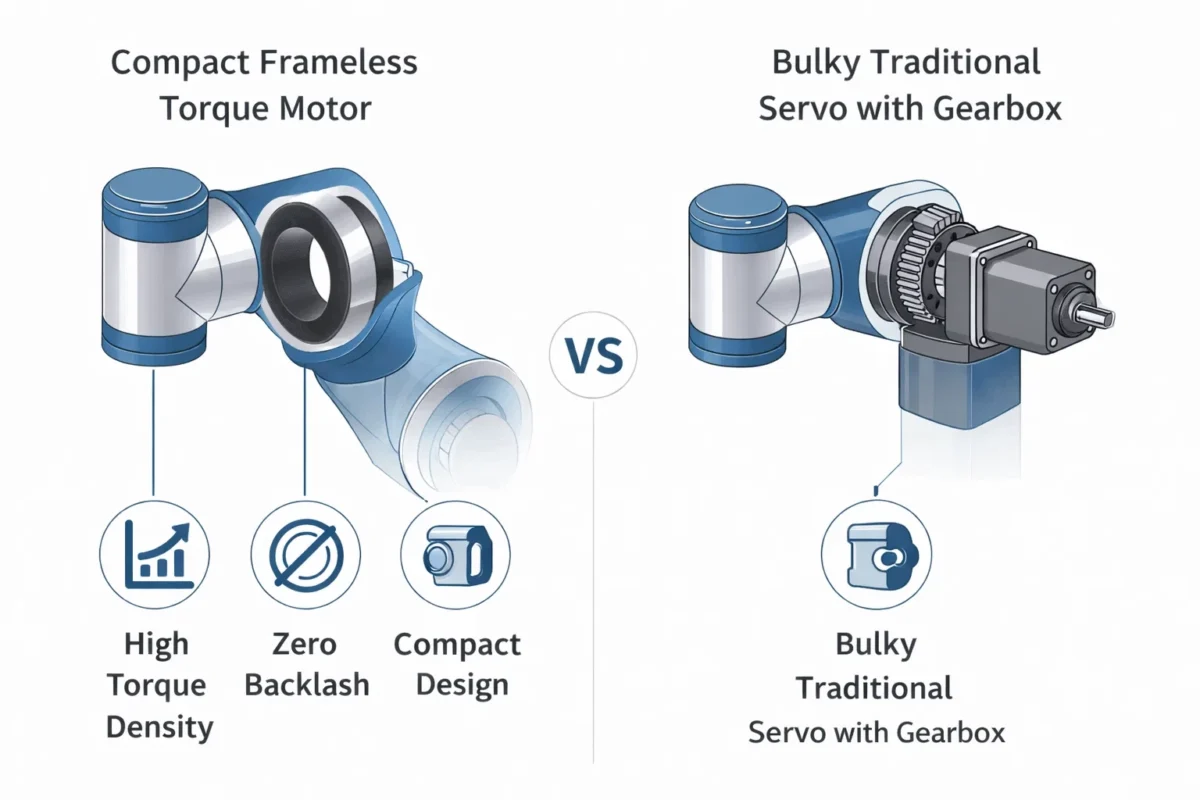
Space is equally constrained. Inside a missile guidance fin or a compact tactical gimbal, the available internal volume is measured in cubic centimeters. Engineers must maximize power density—delivering the highest possible continuous and peak torque from the smallest possible physical footprint. This requirement drives the adoption of direct-drive frameless motors and highly integrated rotary joints.
Surviving Harsh Environments: Vibration, Temperature, and Vacuum
Deploying electronics outside of a controlled factory floor means confronting nature at its most destructive.
Mitigating Structural Resonance Under Heavy Launch Vibration
During rocket launch or military vehicle transit, systems endure violent random vibrations across a wide frequency spectrum. If an actuator lacks structural rigidity, these vibrations will cause resonance, leading to degraded sensor data or complete mechanical fatigue. High-rigidity bearings and optimized housing designs ensure that compact actuators maintain structural integrity despite high-frequency shocks.
Thermal Management in Deep Space and Desert Deployments
Thermal environments in defense applications are bipolar. A satellite in low-Earth orbit cycles between blistering solar radiation (-150°C to +120°C), while ground-based tactical vehicles face scorching desert heat. Motion components must feature specialized thermal paths, low-outgassing materials, and wide-temperature electronics to prevent thermal drift and maintain absolute pointing accuracy.
Key Applications: From EO/IR Gimbals to Satellite Communications
The unique mechanical benefits of compact actuation make them the standard across several key defense and aerospace sub-sectors.
Precision Positioning in Electro-Optical/Infrared (EO/IR) Pods
Modern surveillance relies on Electro-Optical and Infrared pods to track targets day or night. These systems require multi-axis gimbals that can perform ultra-slow, jitter-free tracking while maintaining absolute coordinate lock. Zero-backlash compact actuators eliminate micro-reversals and gear play, ensuring crystal-clear video feeds even at extreme optical zoom.
High-Reliability Actuation in Unmanned Systems and Radar
Unmanned Ground Vehicles (UGVs) and tactical radar arrays rely on continuous, unassisted operation. Actuators in these systems must be sealed against dust, sand, and heavy rain (high IP ratings) while delivering reliable torque to point heavy communication dishes or weapon stations in high winds.
How Frameless Motors and Integrated Actuators Deliver Defense-Grade Performance
Meeting military standards requires moving away from off-the-shelf commercial parts and embracing specialized motion engineering.
Eliminating Failure Points with Direct-Drive Mechanics
By removing mechanical gears, belts, and timing chains, direct-drive frameless motors eliminate the most common points of mechanical failure. With fewer moving parts to wear out, the system’s operational lifespan increases exponentially, ensuring high reliability in the field.
Ruggedized Enclosures and High-Reliability Encoders
Defense-grade compact actuators incorporate ruggedized feedback mechanisms, such as robust magnetic or inductive encoders, that are immune to dust, shock, and magnetic interference. Combined with hard-anodized or corrosion-resistant metallic housings, these units are built to withstand the toughest military specifications (MIL-STD compliance).
Conclusion: Precision That Performs Under Pressure
Aerospace and defense engineering leaves no margin for second chances. When mission success depends on the precise movement of a control surface, a sensor, or an antenna, the hardware must be engineered to excel under extreme pressure.
By combining low weight, high torque density, and ruggedized environmental sealing, the modern compact actuator gives defense contractors the competitive edge they need. In the skies, on the ground, or in orbit, precision motion is the silent partner of mission success.
FAQ Section: Aerospace and Defense Motion Control Q&A
Q1: How do compact actuators maintain accuracy under extreme thermal shifts in aerospace deployments?
Aerospace actuators utilize materials with carefully matched coefficients of thermal expansion to prevent internal binding. Additionally, integrated absolute encoders track true output position directly, bypassing any thermal growth or minor expansion in the intermediate drivetrain components.
Q2: Are frameless motors resistant to high levels of shock and vibration typical in defense applications?
Yes. Because frameless motors consist of a simple rotor and stator without independent internal bearings or separate housings, they have very few parts to vibrate loose. When integrated directly into a ruggedized machine chassis, they exhibit exceptional resistance to high G-force shocks and launch vibrations.
Q3: Do you offer custom materials or modified housing coatings to meet specific military standards?
Yes. Mission-critical projects often require specialized treatments such as chemical-resistant anodization, custom high-temperature winding impregnations, or specific fastener platings to meet rigorous military and aerospace environmental standards.