 Joint Rotary Actuators Series HAT
 Joint Rotary Actuators series HAS
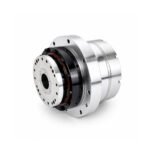 Joint Rotary Actuators Series HAMF
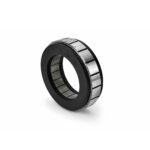 Frameless Torque Motor HBM
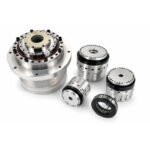 Rotary Actuators
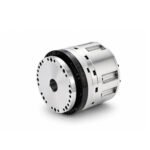 Joint Rotary Actuators Series HAG
 Rotary Actuators Series HPG
Introduction: The Backbone of Sub-Micron Robot Accuracy
In the pursuit of elite-level robotics, a common misconception often leads designers astray: the belief that “more torque equals more precision.” While torque provides the raw strength to move a load, it does not guarantee where that load will end up. The true determinant of positioning stability and dynamic fidelity is torsional stiffness.
Think of a robotic arm as a series of springs. If those springs are too soft, the arm will bounce, sag under its own weight, and vibrate during rapid movements. To achieve true robot accuracy, engineers must prioritize high rigidity at the joint level. This article explores why torsional stiffness is the silent backbone of precision motion control.
What is Torsional Stiffness and Why Should Engineers Care?
Technically, torsional stiffness is the ratio of applied torque to the resulting angular displacement. In simpler terms, it measures how much a robotic joint “twists” when it encounters resistance.
Defining Nm per Arc-Minute: The Language of Precision
In the robotics industry, we measure stiffness in Newton-meters per arc-minute (Nm/arc-min). An arc-minute is just 1/60th of a degree. A high-performance actuator might have a stiffness of 100 Nm/arc-min, meaning you would need to apply 100 Nm of torque just to cause a one-sixtieth-of-a-degree deflection.
Measuring the Mechanical “Spring” Effect in Gearboxes
Every mechanical component—from the motor shaft to the gear teeth—acts like a structural spring. In a complex multi-axis arm, these small deflections accumulate. If your base joint sags by just a few arc-minutes, the tip of a one-meter arm could be off by several millimeters.
The Direct Link Between Rigidity and Robot Accuracy
The relationship between rigidity and robot accuracy is absolute. If a joint isn’t stiff, your controller’s math will never match the physical reality.
Minimizing Angular Deflection Under Heavy Payloads
When a robot picks up a heavy object, gravity exerts a constant downward torque. A low-stiffness joint will deflect under this load, causing the arm to “droop.” While software can attempt to compensate for this, it cannot account for the dynamic changes in stiffness that occur as the robot moves through different poses.
Maintaining Path Integrity During High-Speed Contouring
During high-speed “contouring” (like laser cutting or 3D printing), the robot is constantly accelerating and decelerating. This creates inertial forces that try to push the joints off-course. A joint with high rigidity resists these forces, ensuring the end-effector follows the programmed path with zero deviation.
How Joint Stiffness Dictates Your Control Loop Bandwidth
For motion control engineers, stiffness is the “speed limit” of the system’s intelligence.
Resonant Frequencies: Why a Stiffer Robot is Easier to Tune
Every mechanical structure has a natural resonant frequency. A “soft” joint has a low resonant frequency, which often overlaps with the frequencies the servo motor uses to control movement. This leads to loud humming or violent shaking (oscillation). By increasing torsional stiffness, you push the resonant frequency higher, allowing for much more aggressive and precise tuning.
Overcoming the Oscillations of “Soft” Joints
If a joint is too flexible, the motor might reach the target position, but the load (the arm) will continue to wobble like a diving board. This increases “settling time”—the time your robot has to wait before it can perform its next task. Stiff joints stop instantly, maximizing throughput.
Engineering Strategies for High Rigidity Joints
At Hobber Drive, we use several advanced strategies to ensure our joint modules meet the highest rigidity standards.
Optimizing Bearing Spacing and Housing Materials
Stiffness starts with the frame. We utilize large-diameter cross-roller bearings with wide spacing to provide massive overturning rigidity. Combined with aircraft-grade aluminum housings, our joints provide a rock-solid foundation for the internal gearing.
The Superiority of Integrated Strain Wave and Planetary Designs
The type of gearbox matters. Our integrated strain wave (harmonic) reducers utilize multiple tooth engagement points, which inherently distributes stress and increases torsional stiffness compared to standard spur gears. For ultra-heavy-duty tasks, our precision planetary series offers the highest possible stiffness-to-weight ratio in the industry.
Conclusion: Designing Robots That Don’t Bend Under Pressure
Torque gets your robot moving, but torsional stiffness keeps it on track. In an era where sub-micron precision and high-speed agility are the new standards, the mechanical integrity of the robotic joint is no longer a secondary specification—it is the primary constraint.
By selecting components engineered for high rigidity, you are not just buying parts; you are buying the stability required for robot accuracy. Don’t let a “soft” joint be the weak link in your high-tech design.
FAQ Section: Engineering Rigidity and Motion
Q1: Is there a trade-off between torsional stiffness and total weight?
Yes, generally. More material often means more stiffness, which increases weight. However, modern FEA (Finite Element Analysis) allows us to place material only where it is needed to resist torque, allowing Hobber Drive to offer high-stiffness modules that remain remarkably lightweight.
Q2: How does temperature affect the stiffness of a robotic joint?
As metals heat up, they expand and their modulus of elasticity can change slightly. High-performance joints use materials with low thermal expansion to ensure that the precision and stiffness you have in the morning are the same as what you have after eight hours of continuous operation.
Q3: Can software algorithms compensate for low mechanical stiffness?
Only to a certain extent. “Active damping” algorithms can reduce vibration, but they cannot fix the underlying lack of physical rigidity. Relying on software to fix poor hardware usually results in a slower robot with reduced bandwidth. The best approach is always a “hardware-first” philosophy.