 Joint Rotary Actuators Series HAT
 Joint Rotary Actuators series HAS
 Joint Rotary Actuators Series HAMF
 Frameless Torque Motor HBM
 Rotary Actuators
 Joint Rotary Actuators Series HAG
 Rotary Actuators Series HPG
Introduction: Beyond Speed and Acceleration
Imagine riding in a high-speed elevator. If the elevator accelerates smoothly, you feel a gentle push against the floor, but the ride is comfortable. Now imagine if that elevator instantly went from zero to maximum acceleration in a fraction of a second. You would be violently thrown to the floor. The top speed and the acceleration rate might be exactly the same in both scenarios, but the physical sensation—the violent shock—is completely different.
In physics and engineering, that violent shock is called “jerk.”
For decades, basic automation focused entirely on controlling speed and acceleration. But as the industry demands faster cycle times and micron-level precision, this is no longer sufficient. To eliminate vibration, protect delicate payloads, and preserve the lifespan of precision hardware, engineers must master jerk control. This article uncovers the physics behind jerk and explains why managing it is the ultimate secret to achieving flawless, smooth motion in advanced manufacturing.
The Physics of Jerk: The Derivative of Acceleration
To control a machine, you must understand the mathematical derivatives of its position.
Defining Jerk in Kinematics (m/s3m/s3)
In kinematics, velocity is the rate of change of position. Acceleration is the rate of change of velocity. Jerk, therefore, is the rate of change of acceleration.
In a linear system, jerk is measured in meters per second cubed (
m/s3m/s3). In a rotational system, such as a robotic joint, it is measured in radians per second cubed (
rad/s3rad/s3). A high jerk value indicates that the acceleration is changing very rapidly. A low jerk value indicates that acceleration is being applied or removed gradually.
How Jerk Introduces Vibrational Energy into a Machine
Why does jerk matter? Because sudden changes in acceleration require infinite forces. According to physics, force equals mass times acceleration (
F=maF=ma). If acceleration changes instantaneously, it introduces a massive spike of high-frequency energy into the mechanical structure. This shockwave excites the natural resonant frequencies of the machine frame, gears, and couplings, turning your robotic arm into a vibrating tuning fork.
Trapezoidal vs. S-Curve Motion Profiles
The impact of jerk is most visibly understood by looking at how a machine is programmed to move from Point A to Point B. This trajectory is called a motion profile.
The Flaw of the Trapezoidal Profile: Infinite Jerk
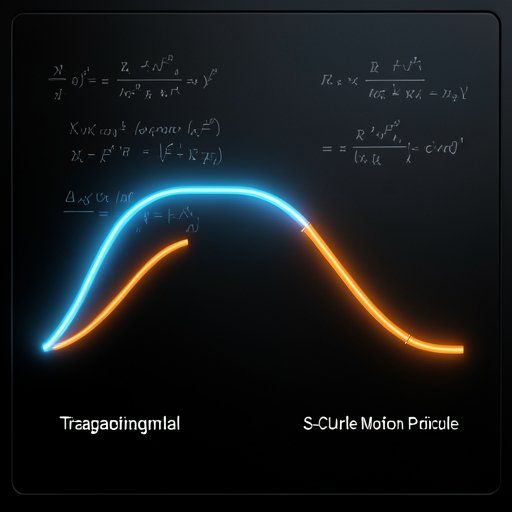
The most basic trajectory planner uses a “Trapezoidal” velocity profile. The motor accelerates at a constant rate, cruises at a constant speed, and decelerates at a constant rate. While the speed curve looks like a neat trapezoid, the acceleration curve looks like a square wave.
At the exact moment the motor begins moving, the acceleration instantly jumps from zero to its maximum value. Mathematically, this instantaneous jump implies infinite jerk. In the physical world, infinite jerk manifests as a brutal mechanical hammer blow to your drivetrain.
How the S-Curve Profile Softens the Transitions
Advanced controllers solve this by using an “S-Curve” motion profile. Instead of a sudden jump, the acceleration is ramped up gradually, held constant, and then ramped down gradually. This smooths out the sharp corners of the trapezoidal velocity profile, making it look like an “S”. By controlling the rate at which acceleration builds up and fades away, the system actively limits the maximum jerk, preventing mechanical shock.
Why High Jerk Destroys Mechanical Systems
Ignoring jerk is not just a software oversight; it has severe physical consequences for your hardware.
Accelerating Wear and Tear on Precision Gearboxes
Precision gearboxes, such as strain wave gears or planetary reducers, rely on microscopic tolerances. When a system operates with infinite jerk (a trapezoidal profile), the gear teeth slam into each other with massive impulsive force every time the motor starts or stops. This repeated hammering breaks down lubrication, accelerates metal fatigue, and rapidly increases backlash, destroying the actuator’s precision over time.
Triggering Mechanical Resonance and Tool Chatter
In CNC machining and high-speed pick-and-place, sudden jerk induces mechanical resonance. If the tool or the payload is vibrating due to a jerky motion profile, the surface finish of the machined part will be ruined by “chatter” marks. In automated optical inspection, the camera will capture blurred images because the mechanical arm is still vibrating long after it has reached its target position.
The Tangible Benefits of Advanced Jerk Control
Implementing jerk control yields immediate, measurable benefits across various high-end automation sectors.
Preventing Liquid Sloshing in Lab Automation and Packaging
In medical laboratory automation, robots must move open vials of blood or chemical reagents at extremely high speeds. In the food packaging industry, machines move open cups of coffee or soup. If the robot moves using a trapezoidal profile, the jerk will cause the liquid to violently slosh and spill. By utilizing an S-Curve profile with strict jerk control, the robot can move even faster without spilling a single drop, because the transitions in force are perfectly smooth.
Achieving Ultra-Smooth Motion and Reduced Settling Time
It seems counterintuitive, but limiting jerk can actually make your machine faster. Because a jerky move causes the robot arm to vibrate at the end of its travel, the system must pause and wait for the vibrations to die down before performing the next task. This is called “settling time.” By smoothing the motion profile, vibrations are never excited in the first place. The robot stops precisely on target without oscillating, slashing settling time to near zero and dramatically increasing overall machine throughput.
Implementing Jerk Control with Modern Servo Drives
Achieving this level of fluid dynamics requires sophisticated control hardware capable of complex real-time mathematics.
Leveraging High-End Motion Controllers for Trajectory Generation
Advanced motion controllers handle jerk at the trajectory generation level. When a PLC or a robot controller commands a move, it calculates a 3rd-order or even 5th-order polynomial curve to ensure that position, velocity, acceleration, and jerk are all continuous and bounded.
Tuning Your Servo Drive for Optimal Jerk Limits
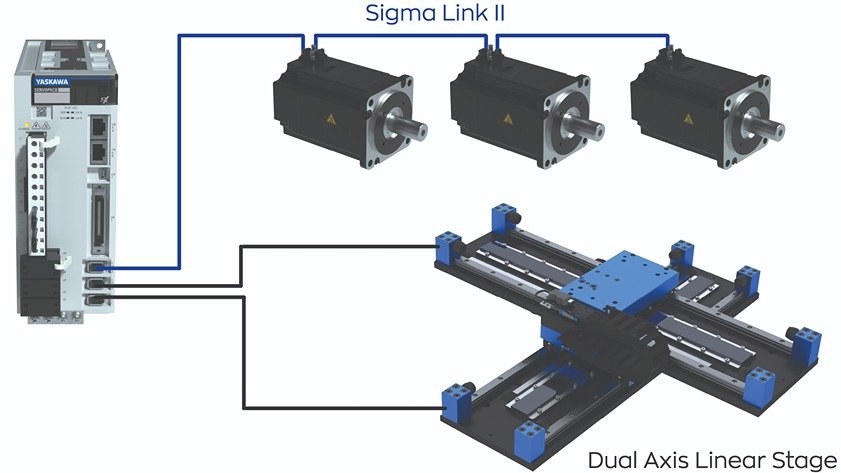
Modern intelligent drives, such as advanced series servo drive architectures, have built-in jerk limiting parameters. When tuning your system, you can define maximum jerk values to protect the mechanics. The drive will automatically “smooth” aggressive incoming commands into fluid S-curves before sending current to the motor. This allows engineers to achieve the ultimate balance between blistering cycle times and whisper-quiet, buttery-smooth operation.
Conclusion: The Art of Seamless Movement
In the race for maximum factory throughput, engineers often obsess over increasing top speed and acceleration. But true precision lies in managing the transitions.
By understanding the physics of jerk control and moving away from rudimentary trapezoidal trajectories, machine builders can unlock the highest echelons of smooth motion. This advanced control strategy not only prolongs the life of expensive mechanical joints and gearboxes but also ensures that fragile payloads are handled with perfect grace. In the end, the fastest machine is the one that never shakes.
FAQ Section: Advanced Motion Kinematics
Q1: What is the unit of measurement for jerk?
In linear motion, it is measured in meters per second cubed (
m/s3m/s3). In rotational systems, which are common in robotics, it is measured in radians per second cubed (
rad/s3rad/s3).
Q2: Are there applications where jerk control is unnecessary?
Yes. In very low-speed applications, or in robust systems moving highly durable materials (like a heavy-duty conveyor belt for rocks), the mechanical compliance of the system can absorb the shock of a trapezoidal profile. In these cases, the extra processing power required for S-Curve profiles might not be necessary.
Q3: What comes after jerk? (Understanding “Snap” or Jounce)
Kinematics doesn’t stop at jerk. The derivative of jerk is called “Snap” (or Jounce). The derivative of snap is “Crackle,” and the derivative of crackle is “Pop.” While mostly theoretical, in ultra-high-precision fields like semiconductor lithography or space telescope stabilization, engineers actually write algorithms to control “snap” to achieve motion that is orders of magnitude smoother than standard industrial robotics.