 Joint Rotary Actuators Series HAT
 Joint Rotary Actuators series HAS
 Joint Rotary Actuators Series HAMF
 Frameless Torque Motor HBM
 Rotary Actuators
 Joint Rotary Actuators Series HAG
 Rotary Actuators Series HPG


Introduction: The Digital Nervous System of Automation
The evolution of the factory floor over the past few decades is a story of digital transformation. We have moved away from complex, hardwired analog I/O harnesses toward streamlined, high-speed digital fieldbuses. Today’s automated machines rely on a web of interconnected devices—controllers, servo drives, sensors, and actuators—that must exchange thousands of data points every single millisecond.
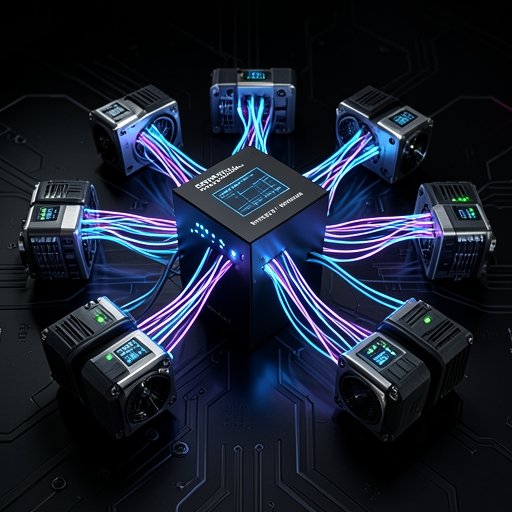
At the heart of this data exchange is the network architecture. Choosing the right industrial communication protocol is just as critical to machine success as selecting the motor or gearbox. If your network suffers from high latency or poor determinism, your multi-axis coordination will fail. This guide compares three of the most widely used protocols in factory automation—Modbus, CANopen, and EtherNet/IP—to help you architect a robust servo drive network.
The Basics of Industrial Communication in Motion Control
Before comparing specific protocols, we must understand why motion control places such unique and demanding constraints on a network.
Determinism, Latency, and Bandwidth Explained
Unlike office IT networks where a brief delay in loading a webpage goes unnoticed, factory automation demands absolute determinism. Determinism means that data packets are guaranteed to arrive at their destination within a strictly defined, predictable time window.
- Latency is the delay between a command being sent and its execution. In fast-moving machinery, high latency causes tracking errors.
- Bandwidth is the volume of data the network can carry. Multi-axis systems requiring real-time position, velocity, and torque feedback demand high bandwidth and ultra-low latency.
Master-Slave Architectures in Multi-Axis Systems
Most motion control networks operate on a Master-Slave (or Client-Server) architecture. The central motion controller (the Master) acts as the conductor, calculating trajectories and broadcasting position setpoints to every servo drive (the Slaves) simultaneously. The communication protocol is the language the Master uses to speak to these Slaves.
Modbus: The Reliable Veteran for Simple Connectivity
Introduced decades ago, Modbus is arguably the most recognized protocol in industrial automation due to its sheer simplicity.
Serial (RTU/ASCII) and TCP/IP Simplicity
Modbus operates on a request-response model. It comes in two primary flavors: Modbus RTU (running over serial RS-485 physical layers) and Modbus TCP (running over standard Ethernet). Because its packet structure is extraordinarily straightforward, almost every industrial device on the market supports some form of Modbus.
Where Modbus Shines (and Where It Falls Short in Motion)
Modbus is brilliant for monitoring parameters, reading temperature sensors, or changing basic configuration variables on a drive where speed is not an issue. However, because it lacks true real-time determinism and operates primarily on a polling mechanism rather than cyclic synchronous updates, Modbus is rarely used for high-speed, multi-axis coordinated motion control.
CANopen: The Compact Standard for Embedded Robotics
When automation engineers need a robust fieldbus specifically tailored for machinery and embedded motion, they frequently turn to CANopen.
Object Dictionary Architecture and PDO/SDO Communication
Based on the robust CAN (Controller Area Network) physical layer, CANopen uses an “Object Dictionary”—a standardized lookup table that organizes all device parameters (like velocity limits, control modes, and actual positions) into a universal map. Data is split into Process Data Objects (PDOs) for high-speed, time-critical cyclic data, and Service Data Objects (SDOs) for configuration.
Why CANopen Dominates Compact Robotic Joints
CANopen provides excellent determinism for smaller multi-axis networks. Its compact message frames and robust error-handling make it a staple in mobile robotics, medical devices, and compact multi-axis articulated arms where wiring space is severely restricted.
EtherNet/IP: High-Bandwidth Integration for Smart Factories
As factories transition toward the Industrial Internet of Things (IIoT) and IT/OT convergence, Ethernet-based protocols have taken center stage.
Leveraging Standard Ethernet Infrastructure for OT/IT Convergence
EtherNet/IP (Ethernet Industrial Protocol) adapts standard commercial Ethernet hardware (switches, routers, cables) for industrial use by utilizing the Common Industrial Protocol (CIP). This allows plant managers to connect their factory-floor servo drives directly to enterprise IT databases, SCADA systems, and cloud monitoring tools without complex protocol converters.
High-Speed Cyclic Data Exchange for Multi-Axis Coordination
By leveraging switched Ethernet and priority tagging, EtherNet/IP can handle heavy data loads while maintaining the cyclic update rates required for synchronized machine control. It has become a dominant standard in large-scale packaging lines, automotive assembly cells, and heavy material handling.
Comparison Matrix: Which Protocol Should You Choose?
| Feature | Modbus TCP | CANopen | EtherNet/IP |
| Real-Time Performance | Low / Moderate | High | High |
| Max Network Speed | High (100+ Mbps) | Moderate (1 Mbps) | High (100+ Mbps / 1 Gbps) |
| Wiring Complexity | Simple (Ethernet) | Simple (Daisy Chain) | Moderate (Standard Switches) |
| Best Suited For | Basic I/O & Monitoring | Compact Multi-Axis & Robotics | Factory-Wide Cell Integration |
Speed and Update Rate Trade-offs
When selecting your protocol, evaluate your axis count and cycle time requirements. If you are building a simple single-axis indexing table, a basic serial protocol or simple fieldbus is cost-effective. If you are synchronizing twenty axes in a high-speed printing press, a high-bandwidth industrial Ethernet solution is mandatory.
Cabling, Topology, and Implementation Costs
Consider the physical installation. CANopen allows for neat, long-distance daisy-chaining with minimal cable counts. EtherNet/IP utilizes star or line topologies through standard switches, offering incredible flexibility and easy troubleshooting using standard IT diagnostic tools.
Conclusion: Speaking the Right Language in Automation
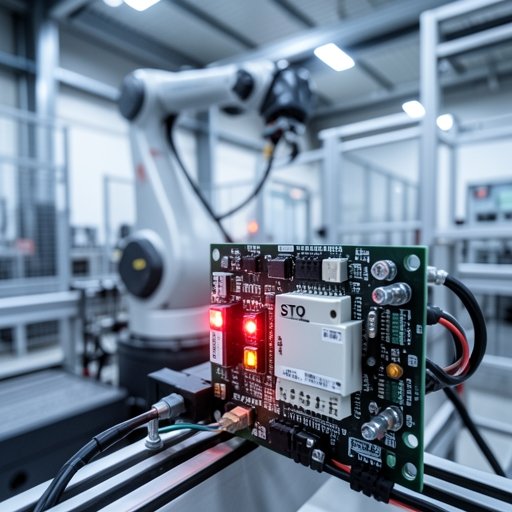
In automation engineering, hardware capability is only unlocked when the communication network delivers commands cleanly and on time. The communication protocol is the vital thread binding the controller, the servo drive, and the physical actuator together into a cohesive machine.
Whether you are deploying a compact mobile robot utilizing CANopen or integrating a factory-wide automation cell via EtherNet/IP, matching your network architecture to your dynamic performance requirements ensures long-term reliability. Modern high-performance drives are designed with multi-protocol flexibility in mind, ensuring they can speak whatever language your control system demands.
FAQ Section: Industrial Networking Q&A
Q1: Can I use Modbus for real-time multi-axis servo synchronization?
Generally, no. Because Modbus relies on a non-deterministic request-response polling model, it cannot guarantee the microsecond-level time synchronization required to coordinate multiple axes in interpolation tasks. For multi-axis motion, real-time fieldbuses or industrial Ethernet variants are required.
Q2: What is the maximum cable length for a CANopen network without a repeater?
The maximum bus length in a CANopen network depends heavily on the baud rate. At the maximum speed of 1 Mbps, cable length is limited to roughly 25 meters. However, if you reduce the communication speed down to 50 kbps, the allowable bus length can extend up to 1,000 meters.
Q3: How does EtherNet/IP differ from EtherCAT in performance?
While both use industrial Ethernet, EtherNet/IP typically runs on standard TCP/IP or CIP Sync models suited for broad factory cell control and IT integration. EtherCAT utilizes a specialized “processing on the fly” hardware architecture specifically optimized for ultra-fast, hard real-time multi-axis motion synchronization with minimal jitter.