 Joint Rotary Actuators Series HAT
 Joint Rotary Actuators series HAS
 Joint Rotary Actuators Series HAMF
 Frameless Torque Motor HBM
 Rotary Actuators
 Joint Rotary Actuators Series HAG
 Rotary Actuators Series HPG

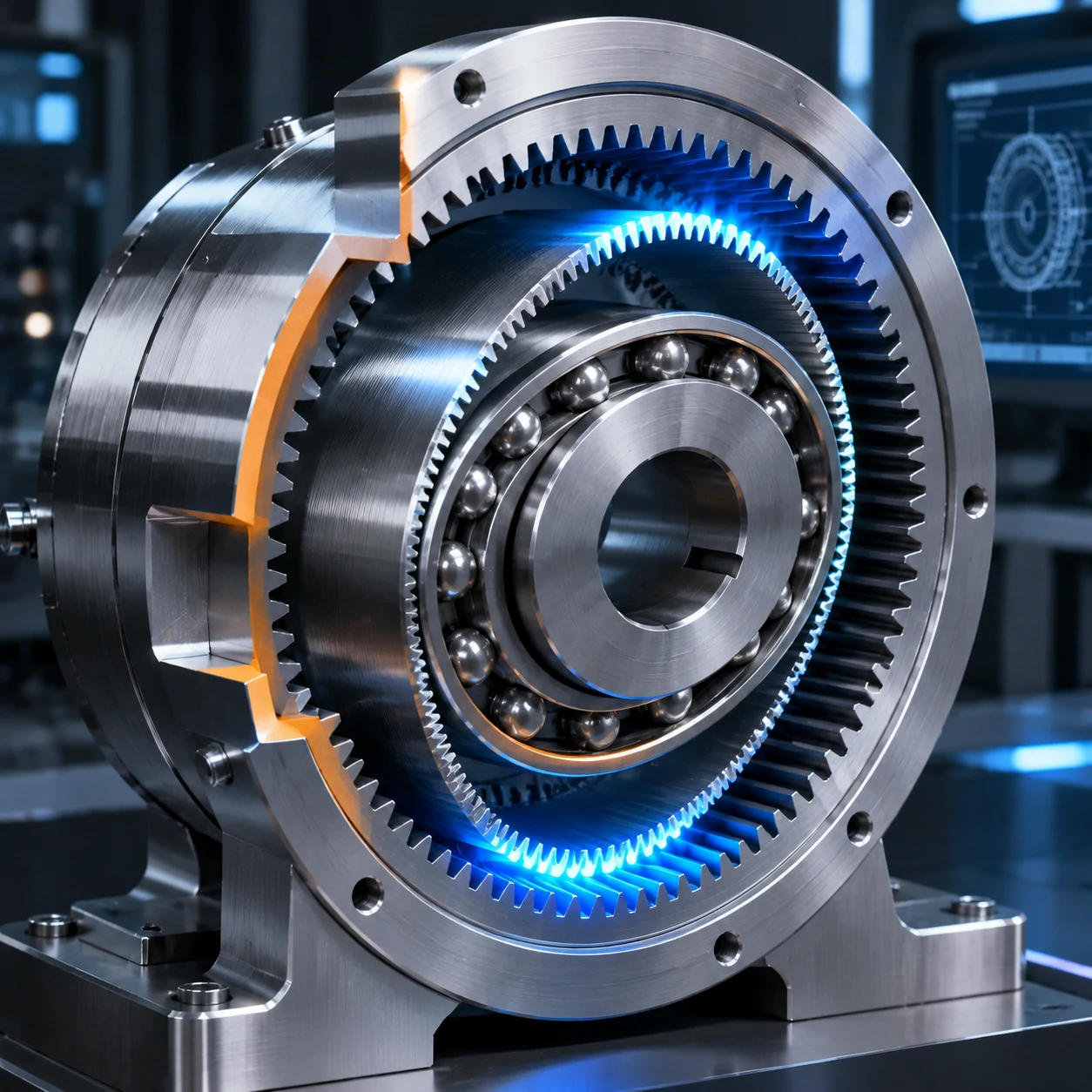
Introduction: The Physics of Absolute Engagement
In the design of modern multi-axis industrial arms, collaborative robots (cobots), and high-precision gimbals, one mechanical requirement is universal: zero backlash. Backlash—the small clearance gap between mating gear teeth—causes reversal errors, trajectory jitter, and positioning slop that can ruin sub-micron accuracy.
While traditional spur and planetary gearboxes struggle to completely eliminate this gap due to manufacturing tolerances, a unique mechanical solution dominates high-end robotics: the strain wave gear, widely known as the harmonic reducer. But how does a metal gear system achieve absolute zero backlash without binding or jamming? This technical deep-dive looks inside the mechanics of strain wave gearing to reveal the physics of elastic deformation.
The Traditional Gear Dilemma: Why Backlash Happens
To appreciate the brilliance of the strain wave gear, we must first look at the inherent flaws of traditional rigid gear trains.
The Inevitable Clearance Gap in Rigid Gear Meshes
In standard rigid gear systems, the teeth of the driving gear and the driven gear cannot fit together with 100% tightness. If they did, thermal expansion and micro-imperfections would cause the gears to lock up completely. To allow smooth rotation, engineers must engineer a microscopic “Clearance Gap” between the mating tooth flanks.
How Backlash Causes Reversal Errors and Trajectory Jitter
This clearance gap is mechanical backlash. When the motor reverses direction, the input shaft must rotate slightly through this empty space before the teeth actually engage the load. During this fraction of a degree, the motor is spinning while the output is standing still. In high-speed path interpolation, this momentary loss of control introduces trajectory jitter and positioning errors.
Anatomy of a Strain Wave Gear (Harmonic Reducer)
Invented in the mid-20th century, the strain wave gear bypassed rigid-body limitations by utilizing a radically different structural geometry consisting of just three core components.
The Elliptical Wave Generator
The input is connected to the wave generator, an elliptical cam fitted with a specialized thin-outer-race ball bearing. When inserted into the assembly, this component forces everything surrounding it to conform to an oval, elliptical shape.
The Thin-Walled Flexspline
The core innovation of the system is the flexspline—a shallow, cup-shaped cylinder made of high-fatigue-limit alloy steel with extremely thin, flexible walls. External gear teeth are cut around the open rim of the flexspline. Because it is mounted over the elliptical wave generator, the flexspline permanently deforms into an oval shape.
The Rigid Circular Spline
Surrounding the flexspline is the circular spline, a thick, rigid ring with internal teeth. The circular spline has slightly more teeth (typically two more) than the flexspline. Because of this tooth-count difference and the elliptical shape imposed by the wave generator, the teeth of the flexspline only engage with the circular spline at two opposing sectors along the major axis of the ellipse.
The Magic of Elastic Deformation: Zero Backlash in Action
The secret to eliminating backlash lies not in rigid manufacturing tolerances, but in controlled material flexibility.
Multi-Tooth Engagement vs. Single-Point Contact
Traditional gears transmit power through single-point or sparse multi-point tooth contact, requiring physical gaps. In a strain wave gear, roughly 30% of the total tooth count is engaged simultaneously across two opposing zones. Because multiple teeth are locked together like a zipper under a continuous radial preload, there is zero room for physical play or clearance gaps.
How the Flexspline Deforms Without Slipping
As the elliptical wave generator rotates, the points of engagement travel smoothly around the circumference of the gear. The flexible walls of the flexspline flex continuously without slipping against the circular spline teeth. This elastic deformation transforms high-speed, low-torque input into low-speed, ultra-high-torque output in a single compact stage, all while maintaining absolute mechanical contact.
Why Zero Backlash Matters for Modern Robotics
The elimination of mechanical play transforms how automated systems perform in the real world.
Achieving Sub-Arc-Minute Positional Repeatability
With zero backlash and exceptional torsional rigidity, strain wave gears achieve transmission accuracy measured in arc-minutes or even arc-seconds. This ensures that when a robotic joint moves to a coordinate, it hits that exact point with absolute repeatability, cycle after cycle, year after year.
Eliminating Lost Motion in Rapid Direction Reversals
In applications involving continuous high-frequency oscillations or rapid vector changes, zero backlash ensures there is zero “lost motion.” The output responds instantly to the motor’s command, resulting in cleaner contours, smoother path tracking, and higher overall system bandwidth.
Conclusion: Perfect Engagement for Perfect Motion
The strain wave gear turned a fundamental material limitation—metal fatigue caused by controlled flexing—into its greatest engineering strength. By replacing rigid tooth clearance with continuous elastic multi-tooth engagement, it conquered backlash at the physical root.
Understanding how a strain wave gear achieves absolute zero-backlash transmission underscores why it remains the gold standard for high-end motion control. When your application demands uncompromising precision, looking inside the mechanics of elastic deformation reveals how engineering turns clever physics into flawless motion.
FAQ Section: Strain Wave Gearing Engineering Q&A
Q1: Does a strain wave gear experience wear that increases backlash over time?
Unlike traditional spur or planetary gears where sliding friction and localized tooth impacts widen the clearance gap over time, strain wave gears distribute loads across 30% of their teeth simultaneously via elastic deformation. This high-contact distribution minimizes localized wear, allowing them to maintain their zero-backlash characteristics for a remarkably high percentage of their operational lifecycle.
Q2: How does the flexibility of the flexspline affect the overall torsional stiffness of the joint?
The thin-walled nature of the flexspline introduces a slight torsional “spring” effect under heavy peak loads. While they offer absolute zero backlash, engineers must balance this against torsional stiffness ratings when designing systems subjected to massive shock loads or extreme inertial changes.
Q3: What are the torque limits before a harmonic reducer suffers from tooth jump?
If a strain wave gear is subjected to an extreme overload (such as a severe mechanical crash or an unexpected hard stop), the teeth under maximum deflection can slip past each other—a phenomenon known as “tooth jump.” High-quality harmonic reducers are engineered with high peak torque limits to protect against this, but system controllers should always be programmed with current limits to prevent accidental overloading.