 Joint Rotary Actuators Series HAT
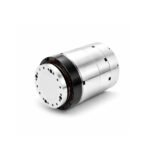 Joint Rotary Actuators series HAS
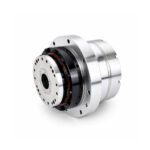 Joint Rotary Actuators Series HAMF
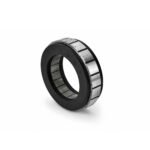 Frameless Torque Motor HBM
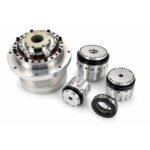 Rotary Actuators
 Joint Rotary Actuators Series HAG
 Rotary Actuators Series HPG

Introduction: The Delicate Art and Brutal Physics of Glass Manufacturing
Glass is a remarkable material. It is transparent, durable, and chemically inert, making it indispensable for consumer electronics screens, automotive displays, architectural panels, and advanced optics. Yet, for all its elegance in finished applications, manufacturing glass is a brutal physical discipline.
Processing glass requires shaping a hard, amorphous, and inherently brittle material at high speeds. A microscopic vibration or an uncompensated flex in a machine tool can instantly ruin an expensive glass pane through micro-chipping or catastrophic cracking. As products demand thinner profiles and more complex geometries, equipment builders must rely on robust motion control and specialized hardware. This article explores how high-rigidity actuators and sealed rotary platforms are transforming automated glass processing across cutting, grinding, and polishing lines.
The Brutal Environment of Glass Machining
Before examining the motion mechanics, one must appreciate the factory floor environment where glass shaping occurs. It is an arena that quickly destroys standard industrial components.
The Hazard of Abrasive Glass Dust and Coolant Slurry
When glass is cut, drilled, or edge-ground, the process creates fine, microscopic glass powder. Mixed with the water-based coolants and oils used to suppress thermal cracking, this creates an abrasive slurry. This mixture acts like liquid sandpaper. If it penetrates a standard motor housing or a conventional mechanical bearing, it destroys internal seals and grinds away at gears within weeks.
Why Standard Actuators Fail Prematurely in Wet Environments
Standard automation hardware built for clean assembly lines cannot survive a wet glass-cutting cell. Without proper ingress protection (IP ratings) and corrosion-resistant materials, standard actuators experience rapid bearing corrosion, electrical shorts, and seal failures. Reliability in glass machinery requires purpose-built hardware designed to lock out moisture and abrasive particulates completely.
Precision Cutting and Drilling: The Need for High Rigidity
Whether scoring flat glass sheets with diamond wheels or drilling mounting holes, the linear and rotary axes must exhibit exceptional stiffness.
Preventing Micro-Chipping Along Glass Edges
Micro-chipping is the formation of tiny, microscopic fractures along the cut line of a glass edge. These chips weaken the structural integrity of the glass, leading to spontaneous shattering later in production or during thermal tempering. Chipping is almost always caused by mechanical compliance or tool chatter. When an axis lacks rigidity, the cutting tool bounces against the glass rather than slicing cleanly through it.
Maintaining Torsional Stiffness During High-Feed Operations
To maximize production yields, machines must run at high feed rates. This imposes severe torsional stress on the rotary stages positioning the glass or orienting the cutting head. Utilizing actuators with high rigidity—such as those featuring zero-backlash strain wave gearing or heavy-duty cross-roller bearings—ensures that the transmission holds its position firmly under heavy cutting loads, eliminating deflection and preserving edge quality.
Optimizing Grinding and Polishing Turntables
After cutting, glass edges must be aggressively ground and then polished to optical clarity. This is typically handled by multi-station indexing turntables.
Smooth Velocity Profiles for Uniform Polish Quality
The polishing phase requires constant, uniform contact pressure and perfectly smooth velocity profiles. Any speed ripple or cogging torque from the driving motor will leave visible swirl marks or uneven thickness on the glass perimeter. Direct-drive technology or high-resolution servo actuators provide the fluid, low-speed smoothness needed to achieve a crystal-clear, mirror-like polish.
Utilizing Hollow Rotary Actuators for Coolant and Air Feedthrough
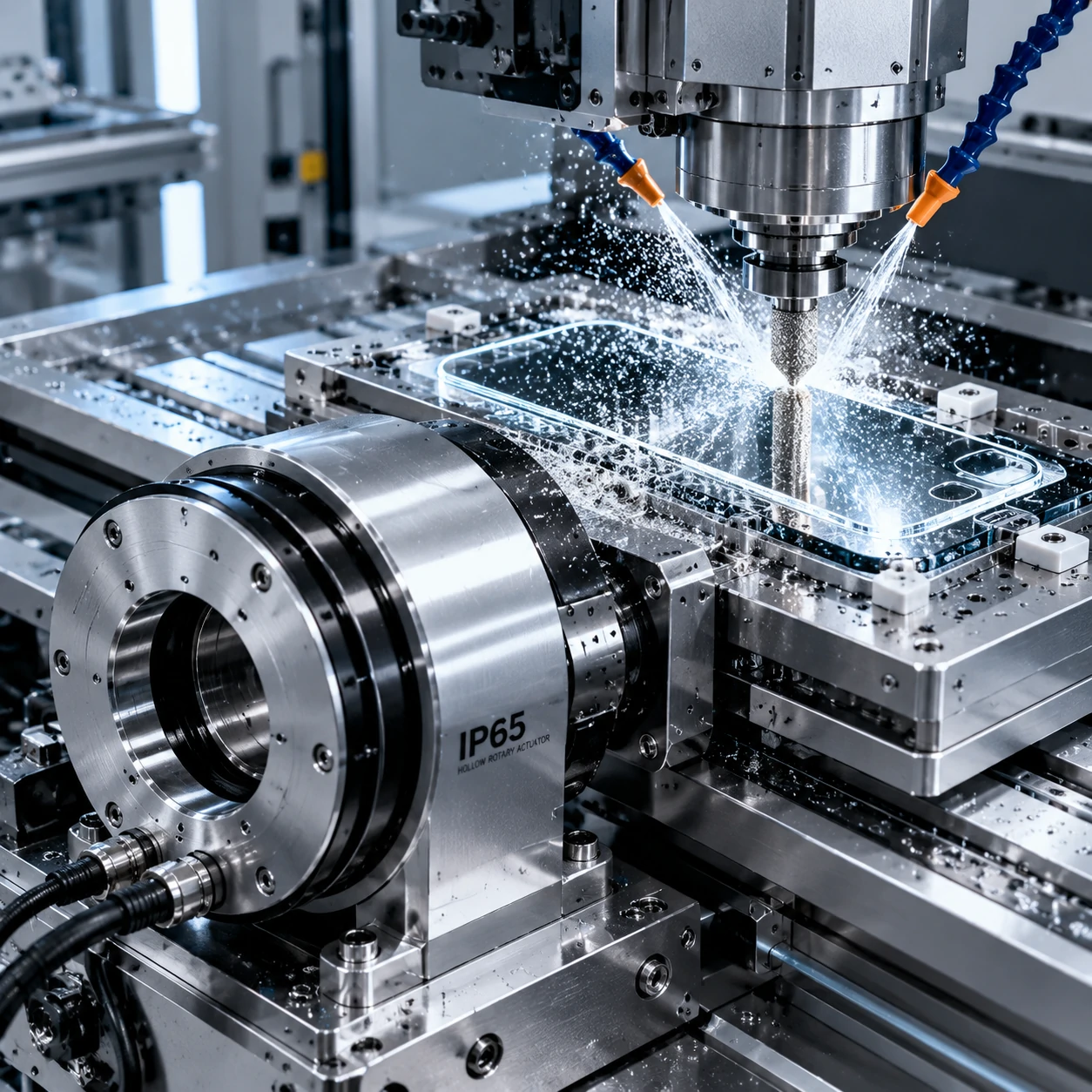
Grinding and polishing heads require constant streams of cooling water and pneumatic clamping for vacuum chucks. A hollow rotary actuator solves this structural dilemma. By providing a generous central hollow bore, the machine designer can route water feedthrough lines and vacuum hoses directly through the center of the rotating indexing table. This eliminates external hose twisting and enables continuous, unhindered rotation.
Engineering for Durability: Sealing Out the Elements
To conquer the harsh conditions of glass fabrication, motion hardware must be engineered from the inside out for extreme durability.
The Critical Importance of IP65/IP67 Sealing in Wet Machining
Actuators destined for glass machinery must feature robust IP65 or IP67 sealing. This means specialized labyrinth seals, durable O-rings, and treated outer casings that actively repel pressurized coolant sprays and abrasive slurries. Sealing the mechanical core ensures that internal components remain pristine, year after year.
Eliminating Maintenance Downtime in 24/7 Glass Lines
Modern glass-processing plants operate around the clock to supply high-volume markets like smartphone manufacturing. Equipment downtime halts entire facilities. By deploying sealed, lifetime-lubricated precision actuators, manufacturers eliminate routine greasing maintenance and prevent unexpected drivetrain failures, ensuring maximum operational uptime.
Conclusion: Perfect Edges Through Advanced Motion Control
Manufacturing brittle materials leaves zero room for mechanical compromise. When your production line deals with abrasive glass dust, heavy coolant slurries, and rigorous cutting forces, your automation hardware must be built to endure.
By integrating robust, waterproof, and high-rigidity motion solutions—such as zero-backlash hollow rotary actuators and smooth direct-drive stages—machine builders can eliminate micro-chipping, accelerate cycle times, and deliver unprecedented quality. In the demanding realm of glass processing, advanced motion control is the ultimate key to a flawless edge.
FAQ Section: Glass Machinery Engineering Q&A
Q1: How do precision actuators prevent glass micro-chipping during high-speed cutting?
Precision actuators prevent micro-chipping by providing high torsional stiffness and zero mechanical backlash. This rigidity prevents the cutting tool from bouncing or chattering against the brittle glass surface, ensuring a clean, uniform fracture line or slice.
Q2: Can hollow rotary actuators withstand direct exposure to glass grinding coolant and abrasive slurry?
Yes, provided they are explicitly specified with industrial-grade IP65 or IP67 ingress protection. These units feature specialized multi-lip seals and corrosion-resistant outer surfaces designed to block abrasive glass slurry from entering the internal gear and bearing cavities.
Q3: What is the advantage of using direct-drive stages over traditional gear motors in glass polishing turntables?
Direct-drive stages eliminate gear mesh and mechanical compliance entirely. This results in smoother low-speed rotation without torque ripple, which is critical for achieving a uniform, scratch-free polish on glass edges during continuous turntable indexing.