 Joint Rotary Actuators Series HAT
 Joint Rotary Actuators series HAS
 Joint Rotary Actuators Series HAMF
 Frameless Torque Motor HBM
 Rotary Actuators
 Joint Rotary Actuators Series HAG
 Rotary Actuators Series HPG
Introduction: Solving the Tangle in Modern Robotics
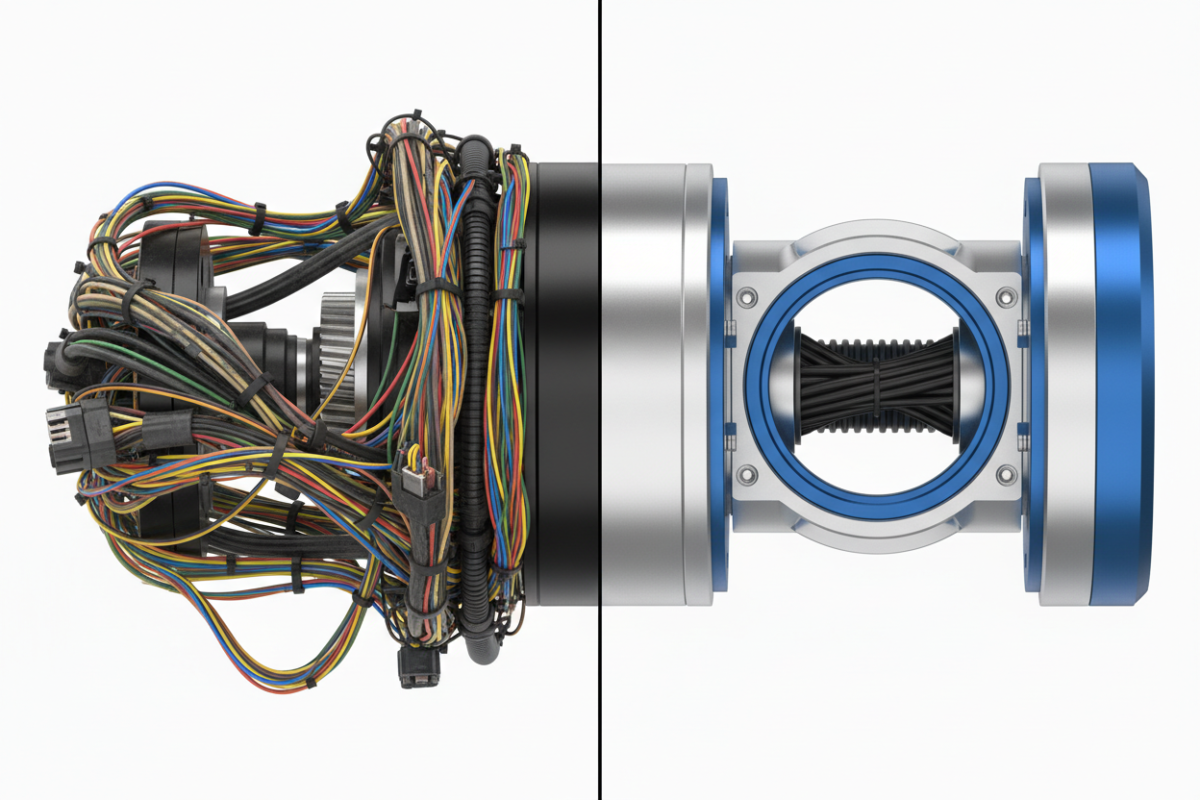
In the world of machine design, cables and pneumatic lines are the veins and nerves of the system. They carry the power and data necessary for high-performance automation. However, they are often the most fragile link in the chain. In traditional designs, cables are draped over the exterior of joints, leading to a “spaghetti” of wires that is prone to snagging, wear, and eventual failure.
The challenge for every engineer is: how do you maintain a full range of motion without destroying your wiring? The hollow shaft actuator has emerged as the foundational solution to this problem. By allowing utilities to pass through the center of the rotation axis, it enables cleaner, more compact, and infinitely more reliable systems. This guide provides best practices for mastering cable management in your next project.
The Failure Point: Why External Cabling Costs You Money
External routing is more than just an aesthetic issue; it is a significant contributor to the Total Cost of Ownership (TCO) of a machine.
The Hidden Costs of Cable Fatigue and Abrasion
When a robotic arm moves, external cables are subjected to constant bending and torsional stress. Over thousands of cycles, this leads to cable fatigue—where internal copper strands break—and abrasion, where the outer jacket wears thin against the machine frame. These failures often result in intermittent signals that are notoriously difficult to troubleshoot, leading to hours of unplanned downtime.
How Tangled Wires Limit Your Robotic Arm’s Range of Motion
If cables are routed externally, the joint’s rotation is often limited to +/- 180 degrees to prevent tangling. This forces the controller to perform “unwind” moves, which increases cycle times and complicates programming. Without effective cable management, you are effectively handicapping the mechanical potential of your robot.
Why Designers Choose a Hollow Shaft Actuator for Wiring
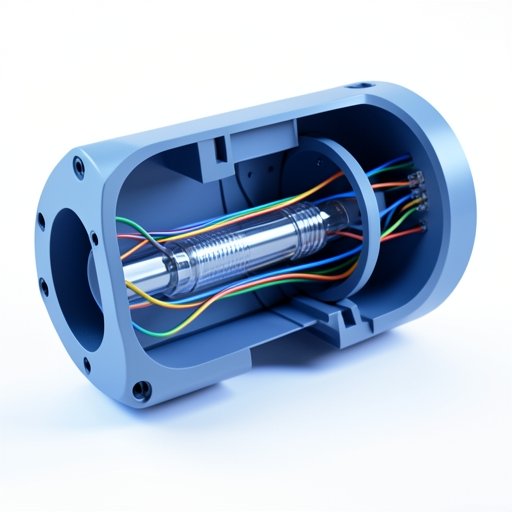
A hollow shaft actuator changes the fundamental architecture of the joint by placing the wiring at the center of the motion, where the relative movement is minimized.
Centralizing the Rotation Axis for Infinite 360-Degree Movement
By passing cables through the hollow bore, the wires only experience a gentle twisting motion along their own longitudinal axis rather than a sharp bending motion around the outside of a housing. This allows for continuous, infinite rotation, which is essential for applications like rotary indexing tables and surveillance gimbals.
Protecting Sensitive Signal Wires from Mechanical Stress
The internal bore acts as a protective conduit. It shields sensitive feedback and sensor wires from external mechanical impacts, falling debris, and harmful fluids like cutting coolants. This physical barrier is the first line of defense for your system’s data integrity.
Best Practices for Internal Cable Management
Successful internal routing requires careful planning. Simply stuffing wires through a hole is not enough.
Calculating the Minimum Bend Radius Inside the Bore
Every cable has a manufacturer-specified minimum bend radius. When cables exit the hollow bore to connect to a sensor or motor, they must not exceed this radius. Ensure that your machine design provides enough “exit room” at both ends of the actuator to allow for a natural, relaxed curve.
Using Cable Carriers and Protective Sleeving
Inside the bore, cables can still rub against the inner wall of the actuator. Use high-flex robotic-grade cabling paired with braided expandable sleeving or smooth plastic wraps. This reduces friction and prevents the cables from “binding” as they twist during rotation.
Separating Power and Data Lines to Reduce EMI
Electromagnetic Interference (EMI) is a risk when power and data are bundled together in a tight space. If possible, use shielded cables for all signal lines and ensure the shields are properly grounded. In larger bore actuators, you can even use internal dividers to keep high-voltage lines physically separate from sensitive data wires.
Sizing the Bore: HAMF vs. HAT Series for Your Design
Choosing the right actuator depends on the volume of your utilities.
When You Need an Enlarged Bore for Pneumatic Lines
If your project requires thick pneumatic hoses for vacuum grippers or fluid lines for cooling, the standard hollow bore may be too restrictive. The HAMF series features an “Enlarged Bore” design specifically for these utility-heavy applications. It provides the maximum possible inner diameter without significantly increasing the outer footprint.
Balancing Compactness and Passthrough Capacity
For standard robotic joints where only a few sensor and power wires are needed, the HAT series offers a more compact profile while still providing the benefits of a hollow center. Always size your bore with at least 30% “free space” to allow the cables room to move and breathe as the joint rotates.
Conclusion: Clean Design is Reliable Design
Integrating a hollow shaft actuator into your design is a long-term investment in machine uptime. While it requires more careful planning during the initial design phase, the rewards are a sleeker machine, a wider range of motion, and a dramatic reduction in cable-related maintenance.
In modern robotics, a clean design is a reliable design. By moving your utilities from the outside to the inside, you are building a system that is ready for the rigors of 24/7 industrial operation.
FAQ Section: Cabling for Hollow Shafts
Q1: How many cables can I realistically fit inside a 50mm hollow bore? As a rule of thumb, you should not fill more than 60-70% of the cross-sectional area of the bore. This allows the cables enough room to twist without rubbing against each other or the bore wall, which prevents heat buildup and mechanical stress.
Q2: Does rotating cables internally affect their lifespan? Yes, but in a positive way. Torsional stress (twisting) is generally much less damaging to a cable than bending stress, provided the cable is rated for robotic use. Internal routing typically increases cable life by 3x to 5x compared to external “over-the-joint” routing.
Q3: Can I pass air and water lines through the same actuator? Yes, provided you use high-quality, leak-proof connectors and ensure the lines are secured. Many of our clients use hollow shaft actuators to pass air for grippers and water for liquid-cooled end-effectors simultaneously. Just be sure to account for the larger bend radius required by fluid hoses compared to electrical wires.